Why laundry leaks are deceptive
A laundry room is often a small space that opens to a hallway, a family room or a basement stairwell. When a supply hose splits behind the machine, pressurized water sprays or runs steadily until someone turns it off. A drain overflow behaves differently: soapy water spills over the standpipe or the tub during a spin cycle and arrives in surges.
Older laundry rooms in 1960s ranches often have a floor drain or a concrete slab where water drains toward the center, but in raised or carpeted laundry areas water moves under baseboards and into carpet in the next room. That means the dry-out zone can be much larger than the laundry itself.
Supply failure compared with drain overflow
- Type
- Hose burst
- Typical pattern
- Steady flow until shutoff; can run for hours
- What to check
- Shutoff valves behind the machine and the hose age
- Type
- Drain overflow
- Typical pattern
- Short surges that stop between cycles
- What to check
- Standpipe height, clogs in the drain line
- Type
- Loose fitting drip
- Typical pattern
- Slow wetting of the floor behind the machine
- What to check
- Rust or stains on the wall below the valves
What to do in order
Close the supply valves
Turn the two valves behind the washer clockwise. If they are stuck, close the main water shutoff.
Unplug the machine if you can reach the plug from dry ground
Water and plugs do not mix. If the outlet is wet, shut power at the panel only from a dry position.
Remove standing water
A wet vacuum can pull water from tile or vinyl. Carpet and pad hold more than you can extract by hand.
Check below and beside
Look at the ceiling underneath, at the neighboring room and at the baseboard in the hall for dampness.
Record the cause
Photograph the failed hose. A cracked or swollen hose is useful for the insurer to see.
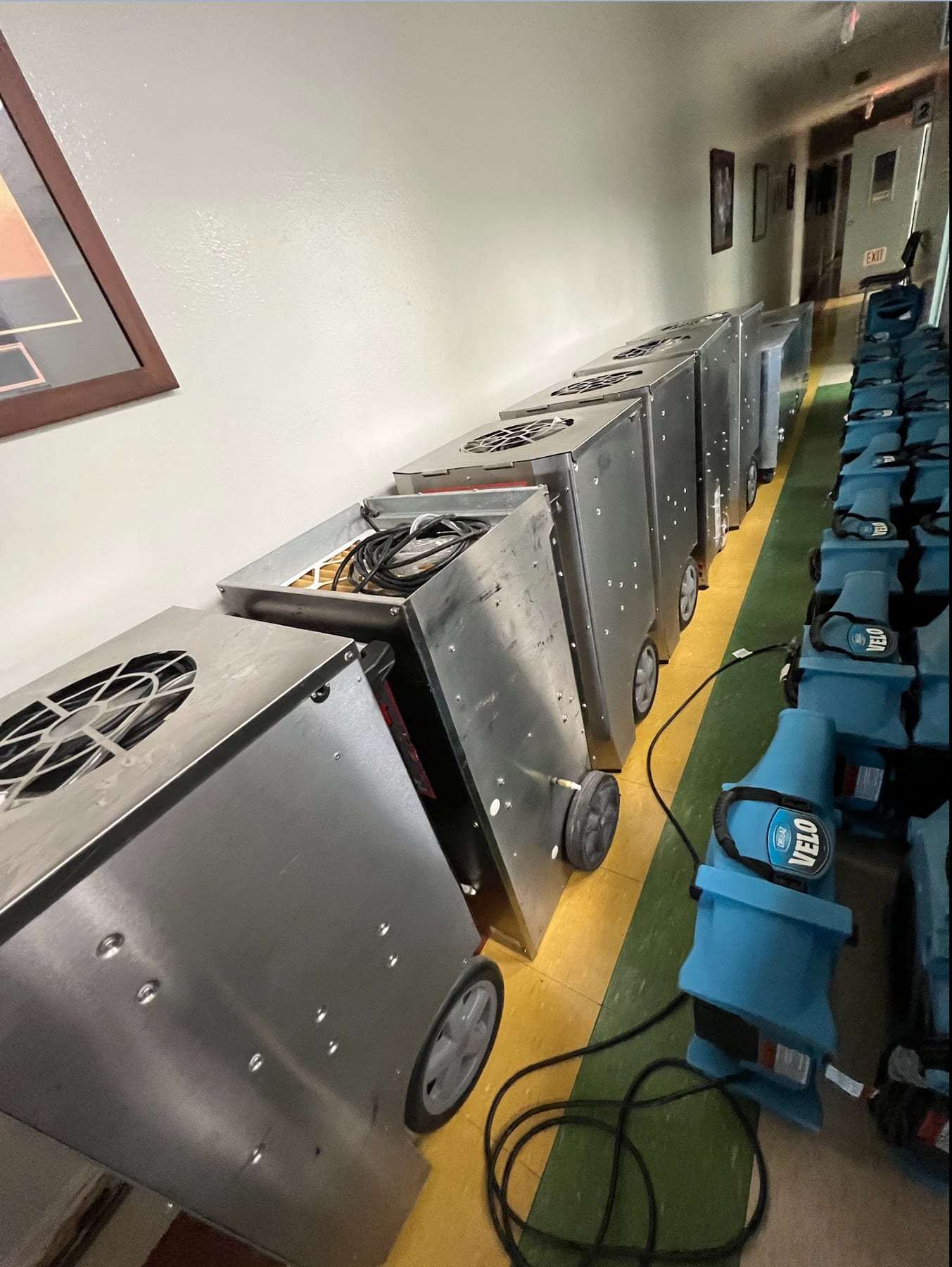
Row of dehumidifiers and air movers drying a long hallway. A general example of this kind of work, not a photo of a particular home, business or job.
Questions to ask once the room is dry enough to assess
- Did water reach the wall cavity behind the machine?
- Is the subfloor or the floor under the washer still reading wet?
- Did water pass into a basement ceiling or a crawl space below?
- Do cabinets or a countertop beside the washer need to be opened for drying?
Common questions
How can I tell if the hose failed or the drain did?
A burst hose usually leaves a lot of water at once and a cracked or split section. A drain overflow leaves soap residue and a wet standpipe area.
Is a floor drain a reason not to worry?
It helps, but carpeted rooms next to the laundry area can still be soaked. Check them with a moisture meter, not by touch alone.
General information for Northglenn, not a quote or professional advice. In an emergency, call 911.